

Overview
White-tailed deer succeed across a remarkable range of landscapes because they adjust food, cover use and movement to local seasons and disturbance.
The species occupies forests, farms, shrublands, wetlands and developed edges; the useful unit for fieldwork is the local cover-and-food pattern, not a generic habitat label. [2]
Body size, antler development, timing and behaviour vary across latitude, nutrition, age and local conditions. Treat regional averages as context, never as an identification test. [1][3]
Identification
Confirm the tail, rump, ears, antlers and gait together. Do not identify a deer from antlers or apparent body size alone.
Adults are reddish-brown in summer and grey-brown in winter; fawns are spotted. The throat, belly, inner legs and underside of the tail carry conspicuous white. [3]
Adult males usually grow antlers with tines rising from a main beam. Antler size is strongly affected by age and nutrition and is not a dependable age measure by itself. [1]
Build an identification
Start with the tail, then confirm several independent traits. A single antler, ear or body-size impression is not enough.
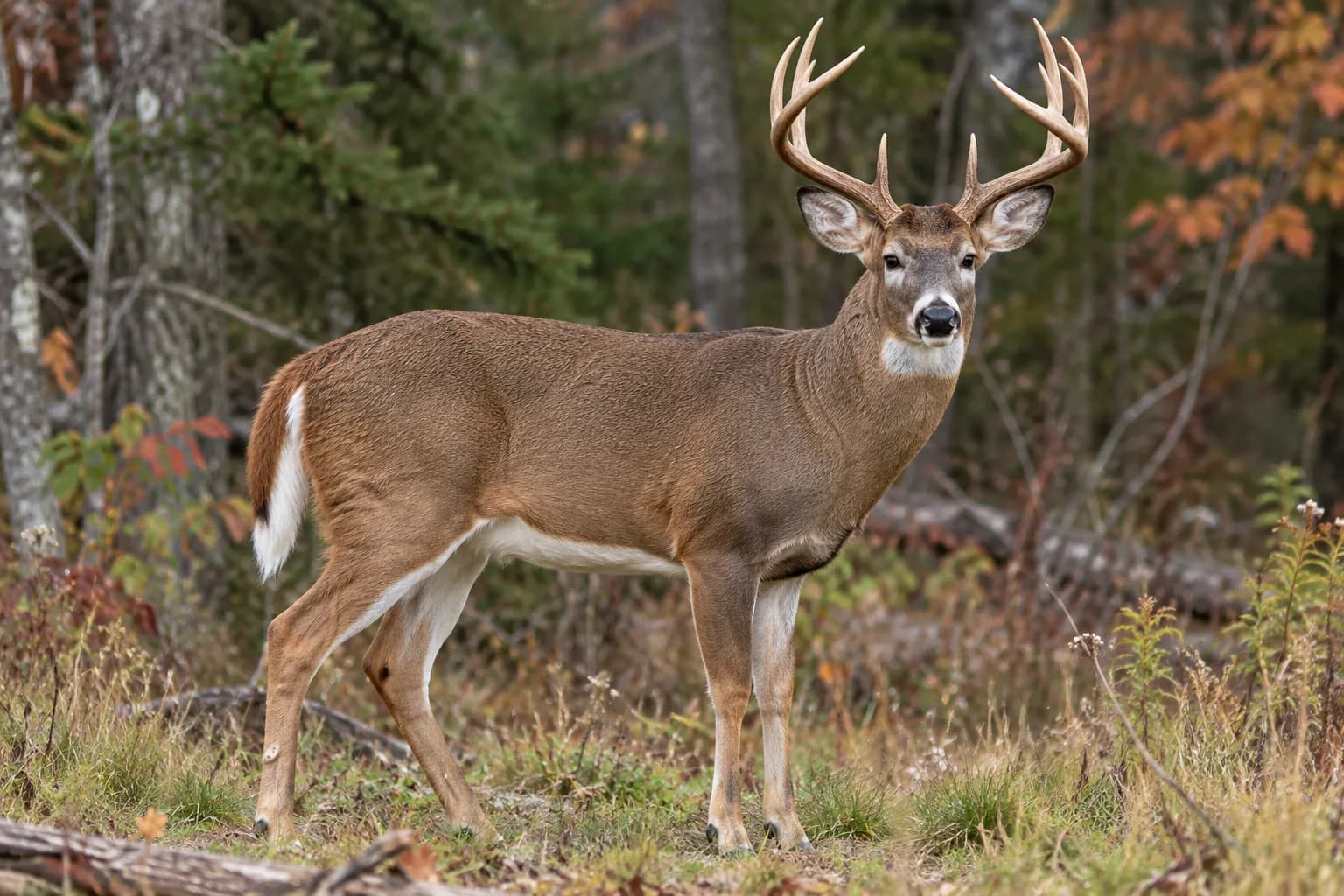
Adult buck
An antlered adult can show the main-beam antler pattern, but the broad white tail underside remains the stronger species mark. [1]
- Look for tines rising from a main beam.
- Age, nutrition and injury change antler form.
- Shed or obscured antlers make sex-class calls harder.
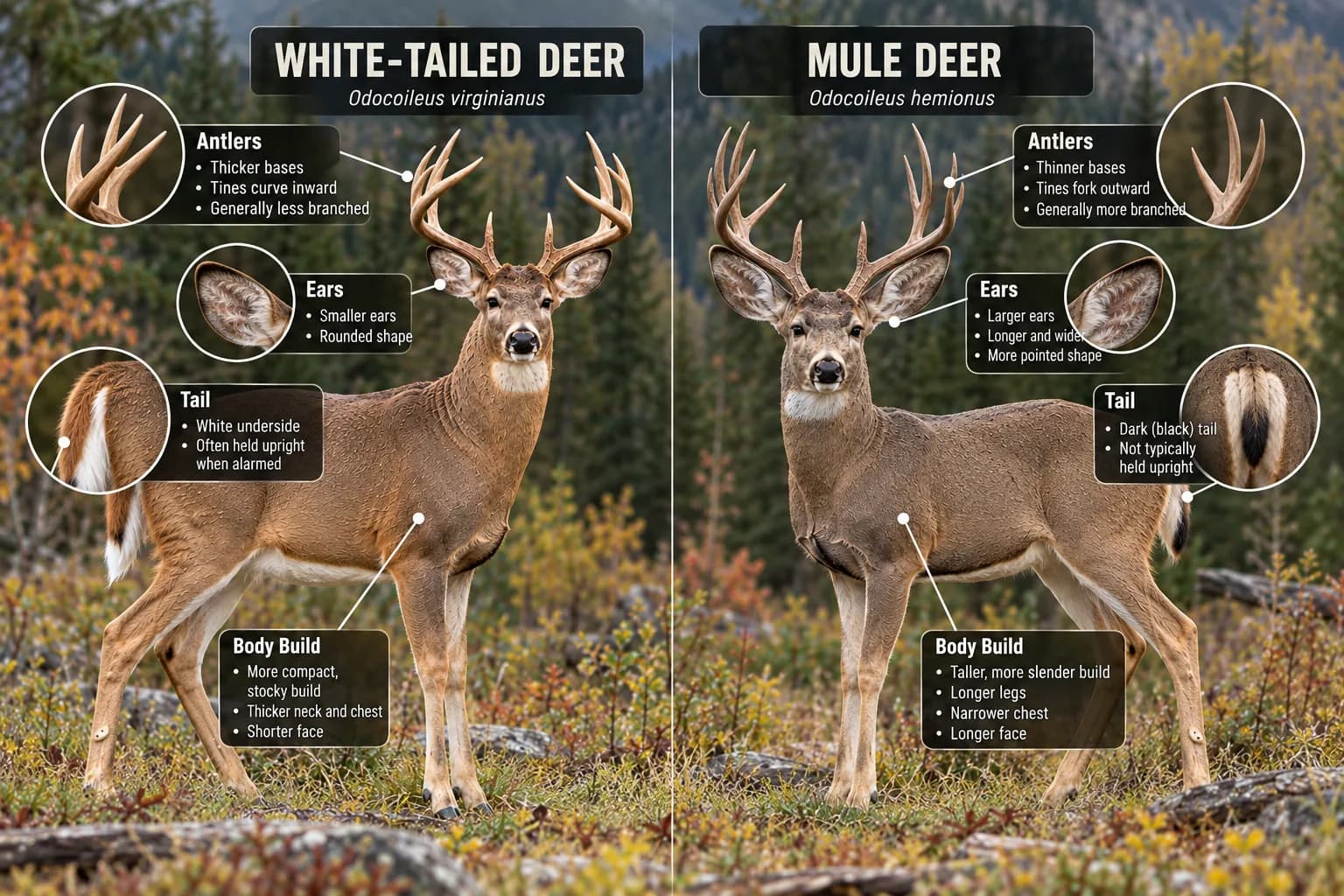
White-tail vs mule deer
Combine tail pattern, ear proportions, antler branching and escape gait; do not decide from body size alone. [3]
- White-tail: broad white underside, commonly raised when alarmed.
- Mule deer: larger ears, black-tipped narrow tail and forked antlers are common.
- Range overlap and individual variation require a multi-trait decision.
If species or legal animal class is uncertain, do not shoot.
Similar species
Where ranges overlap, separate white-tailed deer from mule deer by combining tail pattern, ear proportions, antler branching and escape gait.
Mule deer typically show larger ears, a narrower white tail with a black tip, forked antlers and a bounding or stotting escape gait; white-tailed deer more often run with the broad white tail raised. [3]
Field caution: If the species, sex, age class or antler class is uncertain, do not shoot. Legal definitions are jurisdiction-specific.
Sex and age
Use several body traits at close, unhurried range; biological sex and age are not substitutes for the legal animal-class definition.
Neck, chest, belly line, leg-to-body proportions and behaviour can support an estimate. Obscured antlers, shed antlers and young males make single-feature decisions unsafe. [9]
Species it is confused with
Check these before deciding what you are looking at. If you are not certain what it is, do not shoot.
- Mule deer · Odocoileus hemionus
Field notes
- Identification Antlers are seasonal and do not identify every white-tailed deer. Confirm tail, proportions and local cervid lookalikes before relying on any sex- or age-specific rule.
Habitat
The strongest white-tail habitat puts food near secure cover. Productive edges matter, but an edge with no usable forage or refuge is just a line on a map.
Mixed woodland, regenerating cuts, old fields, riparian corridors, cropland margins and brush can form useful mosaics when forage, concealment and seasonal shelter occur close together. [2]
In northern winters, conifer shelter can reduce wind and snow costs while nearby browse supplies food. Winter concentration areas should not be disturbed unnecessarily. [7]
Read the food–cover pattern
These are functional habitat categories shown by the supplied assets—not promises that deer are present.
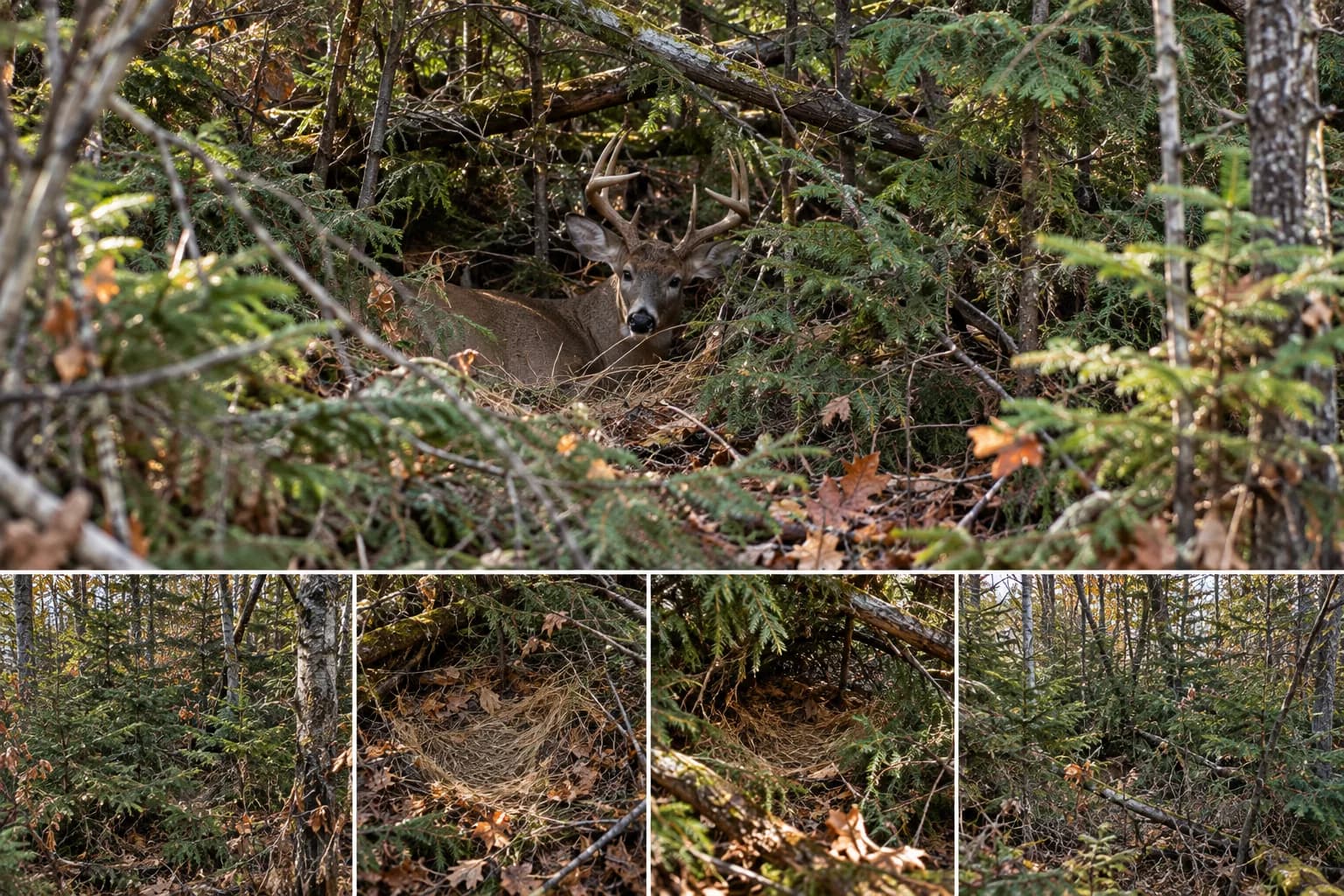
Bedding cover
Dense, sheltered cover can provide concealment, thermal protection and a resting place near food. [7]
- Look for security from repeated disturbance.
- In winter, shelter and snow depth can matter as much as concealment.
- Confirm use with beds, tracks or pellets.
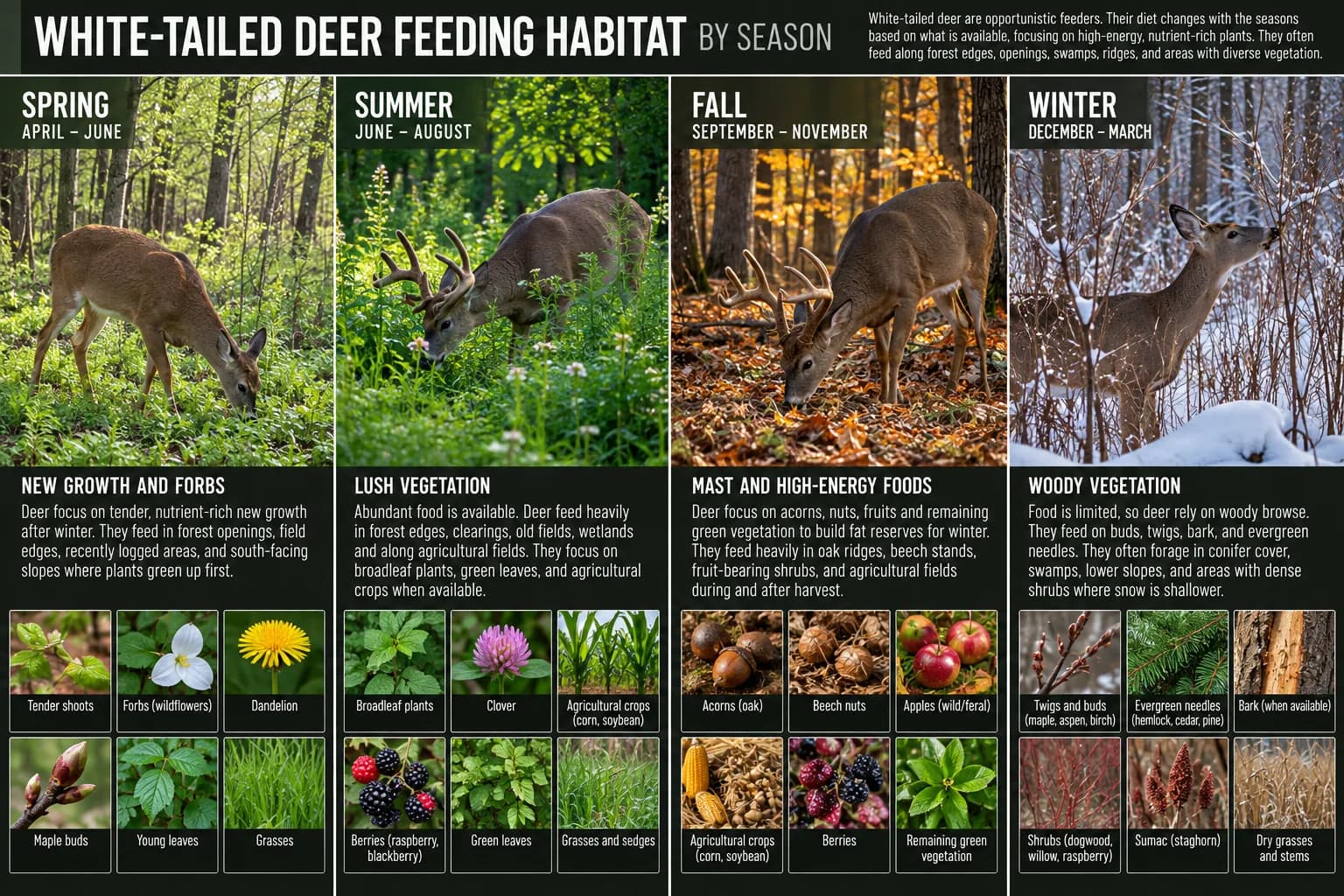
Feeding habitat
Openings, edges, wetlands, old fields and forest understories can supply seasonally changing food. [2]
- Availability changes with local plant communities.
- Mast or crops can reorganize autumn movement.
- Food without nearby security cover may see little daylight use.
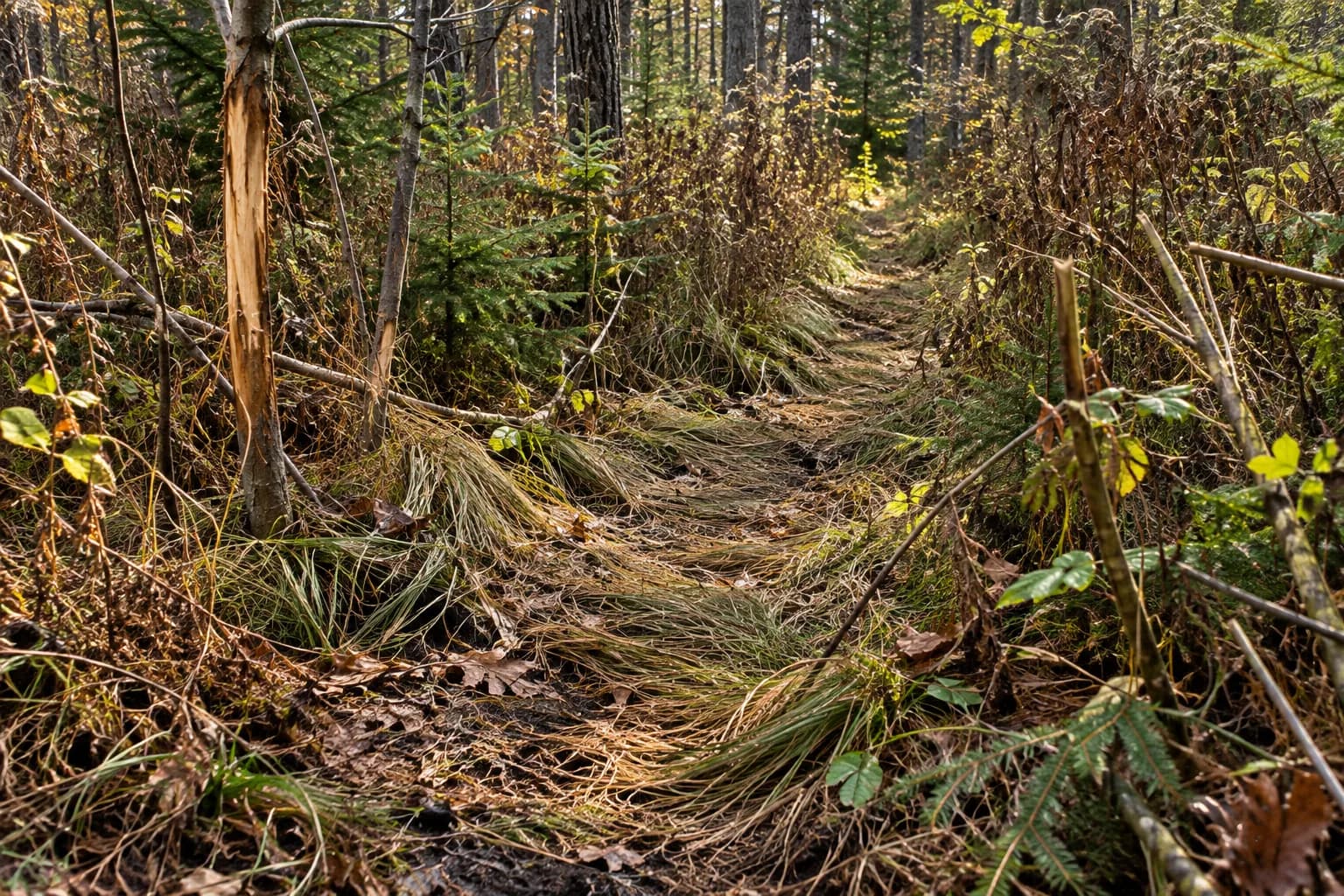
Travel corridors
Trails, cover transitions and barriers can connect bedding and feeding needs or narrow movement. [5]
- Map geometry proposes a corridor.
- Repeated, fresh sign confirms present use.
- Plan access so you do not cross the route you intend to watch.
How to read habitat
Start with transitions: bedding cover to feeding cover, upland to wet ground, mature timber to regeneration, or a barrier that narrows travel.
Aerial imagery proposes a pattern; tracks, pellets, browse, beds and current trails must confirm that deer are using it now. [5]
Diet
White-tailed deer are selective, flexible feeders. The locally important food changes with plant community, weather and season.
Diet may include leaves and stems of woody plants, forbs, grasses, fungi, fruits, nuts and agricultural crops. Mast such as acorns can reorganize autumn movement where it is abundant. [2]
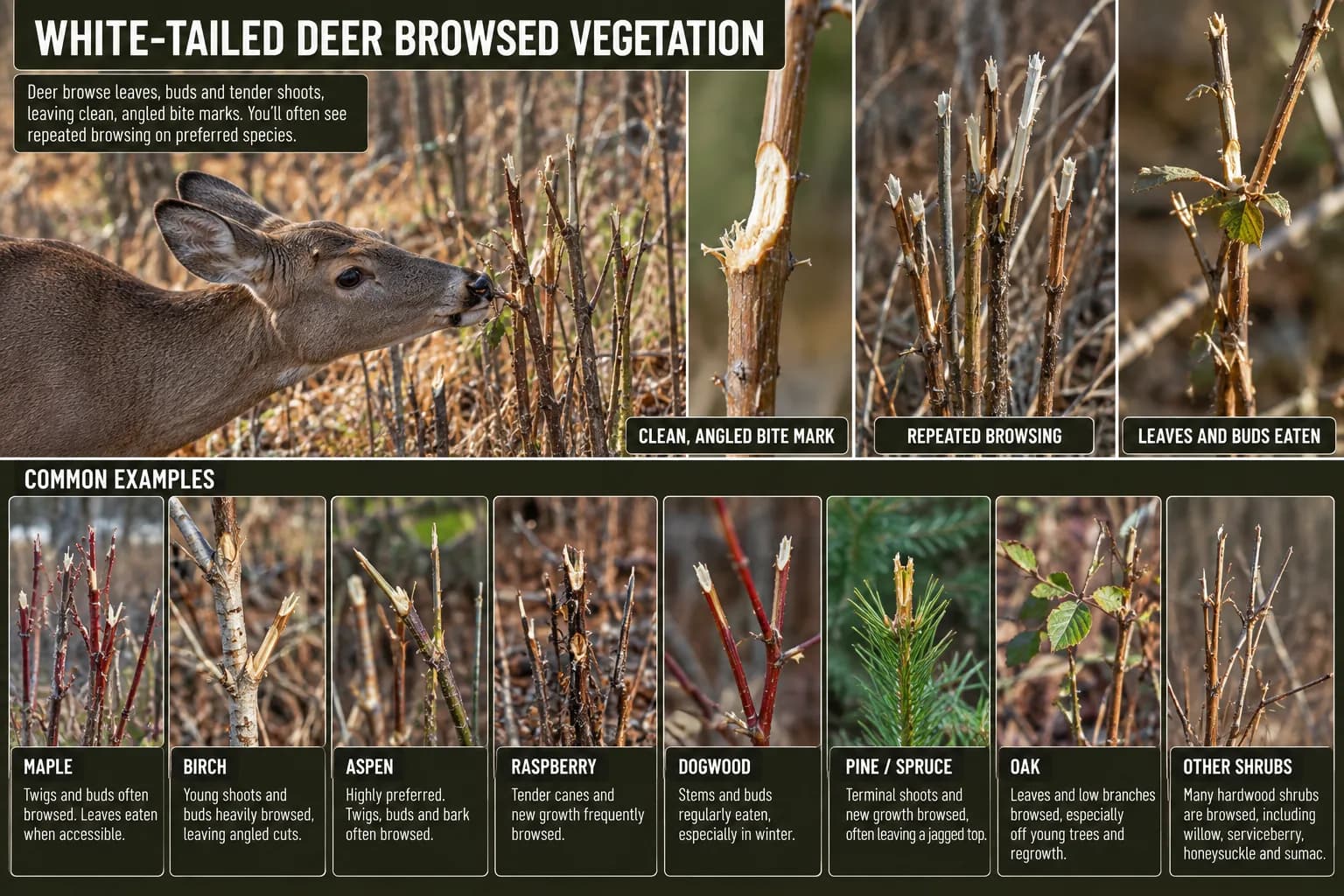
Browsed twig tips, clipped vegetation and a visible browse line can show repeated feeding, but they are not species proof without tracks, pellets or direct observation. [6]
Food changes with the season
The calendar is illustrative. Latitude, weather, plant community and agriculture determine what is actually available.
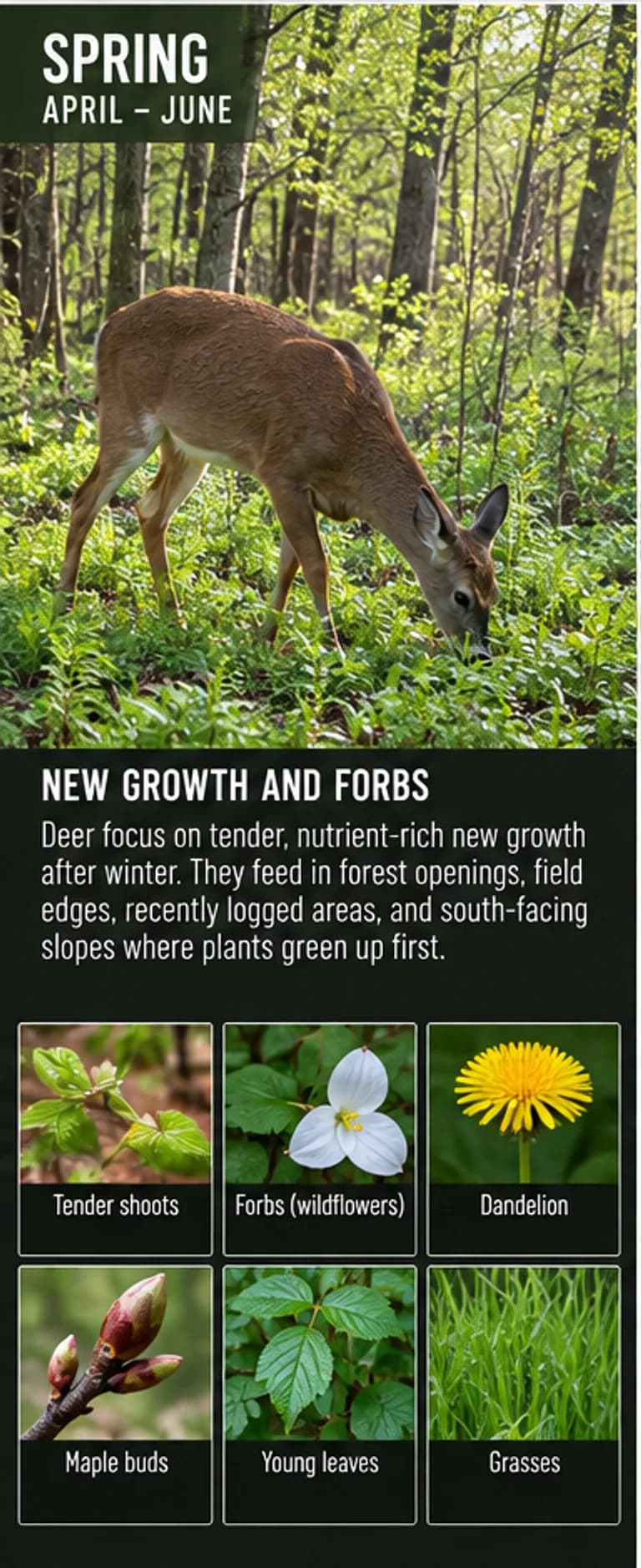
Spring
Emerging green growth and forbs can become important as dormancy ends. [2]
- Check sun-facing slopes and early openings.
- Tender shoots are examples, not a universal menu.
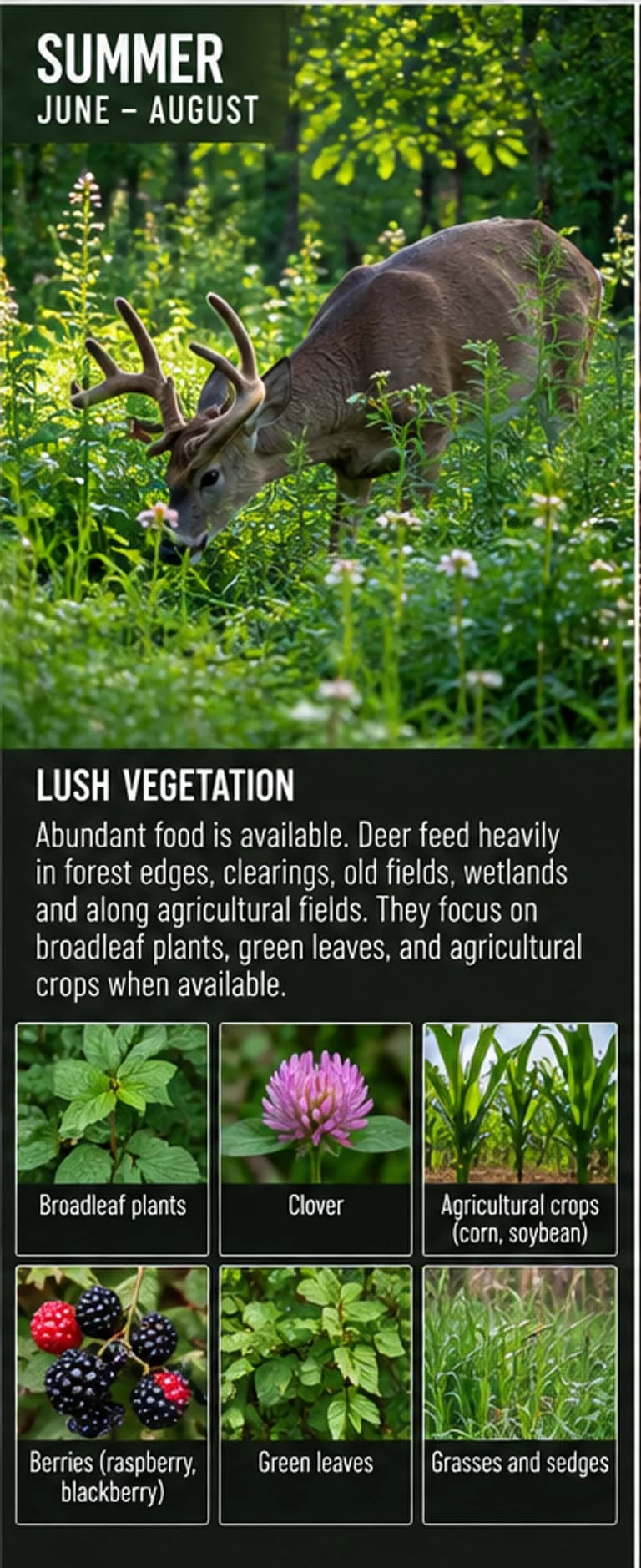
Summer
Leaves, forbs, soft mast and agricultural plants can provide diverse forage. [2]
- Food is often dispersed through abundant cover.
- Local crops and phenology change movement.
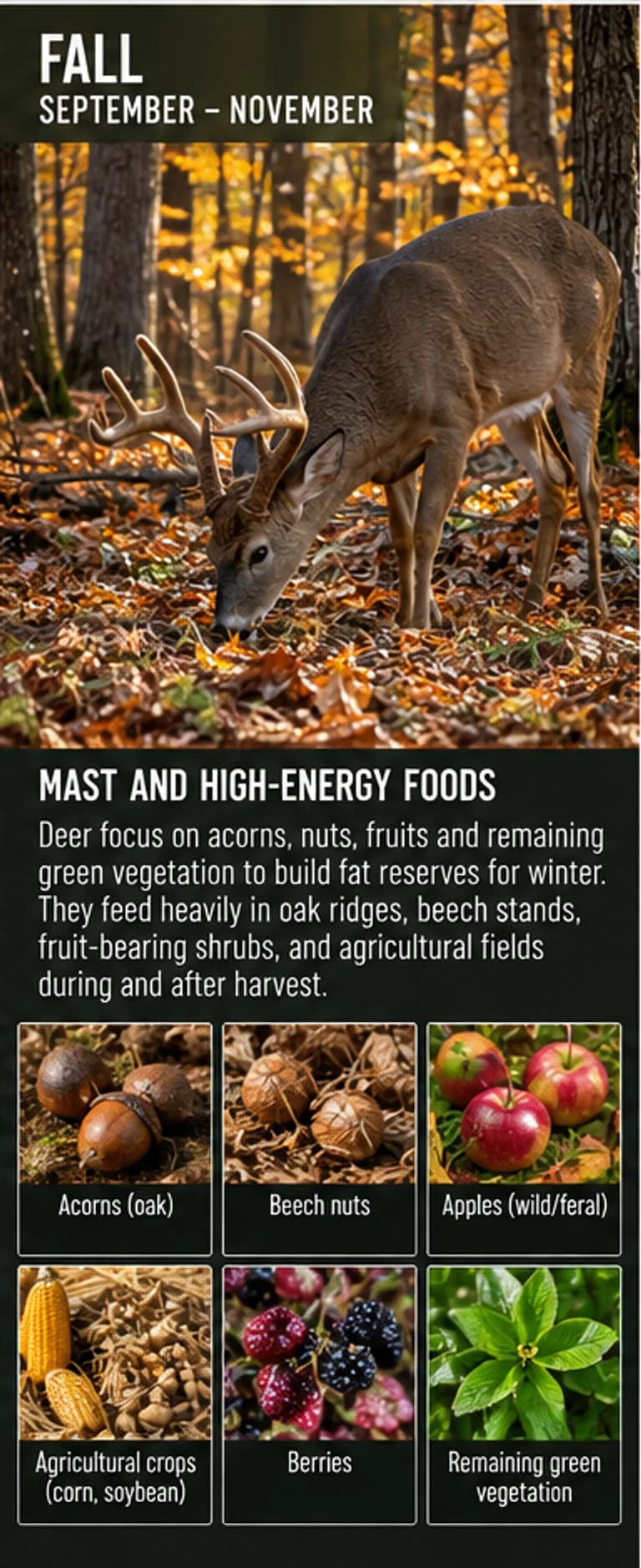
Fall
Mast, fruit and crops can concentrate feeding where they are abundant. [2]
- Acorn availability can shift routes quickly.
- Confirm the food is present this year, not merely mapped.
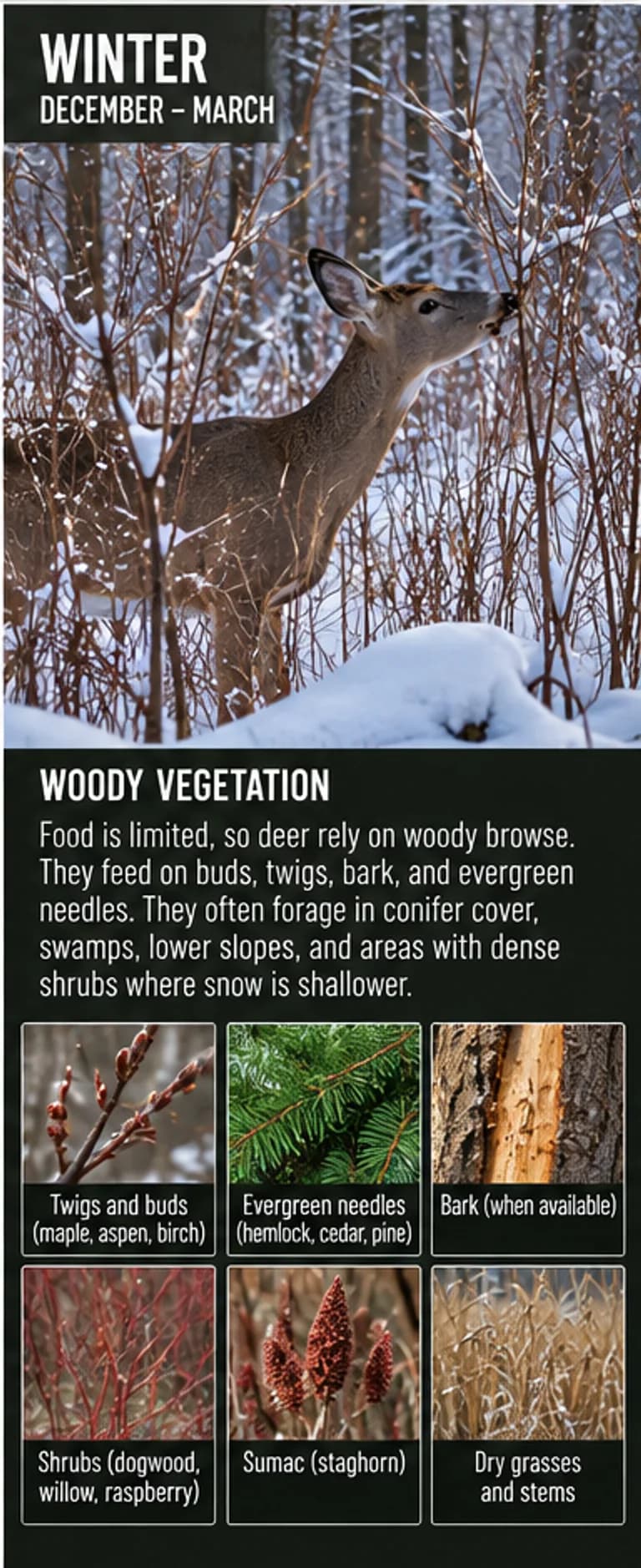
Winter
Woody browse and sheltered feeding areas become more important when green forage declines. [7]
- Deep snow raises travel costs.
- Avoid needless disturbance around concentrated wintering deer.
Field observation: stomach contents
Stomach contents can record what one harvested animal ate recently; they do not define the species' full diet or prove that a food is important across the season.
Where examination is lawful and appropriate, record identifiable material, location, date and uncertainty. Treat the observation as a local clue to compare with available plants and browse—not as a recipe for other places or times. [2]
Field caution: Use gloves and follow local carcass-handling, testing and disposal guidance. Never taste unknown plant material or infer food safety from deer use.
Behaviour
Movement is often strongest around dawn and dusk, but cover, weather, food, breeding and human pressure can move activity into other hours or denser cover.
White-tails commonly use familiar home ranges and travel routes. They may tighten movement, favour thicker cover or become more nocturnal where disturbance is repeated. [2][3]
A raised flagging tail, abrupt snort or bounding retreat signals alarm. Freeze, identify the wind and avoid pushing deer toward roads, property boundaries or other hunters. [1]
Tracks and sign
A single track says a deer passed. Direction, freshness, repetition and the surrounding cover are what turn sign into useful field knowledge.
Typical tracks show two pointed toes and an overall heart shape. Soft ground, speed and splayed toes can enlarge or distort them, so dimensions are supporting evidence only. [4]
Rubs are bark-scraped stems associated mainly with antlered deer. Scrapes are pawed ground often beneath an overhanging branch. Neither guarantees daylight use or an animal's current location. [5]
Read sign in context
Select a sign, then test it against freshness, repetition, weather and the surrounding food–cover pattern.
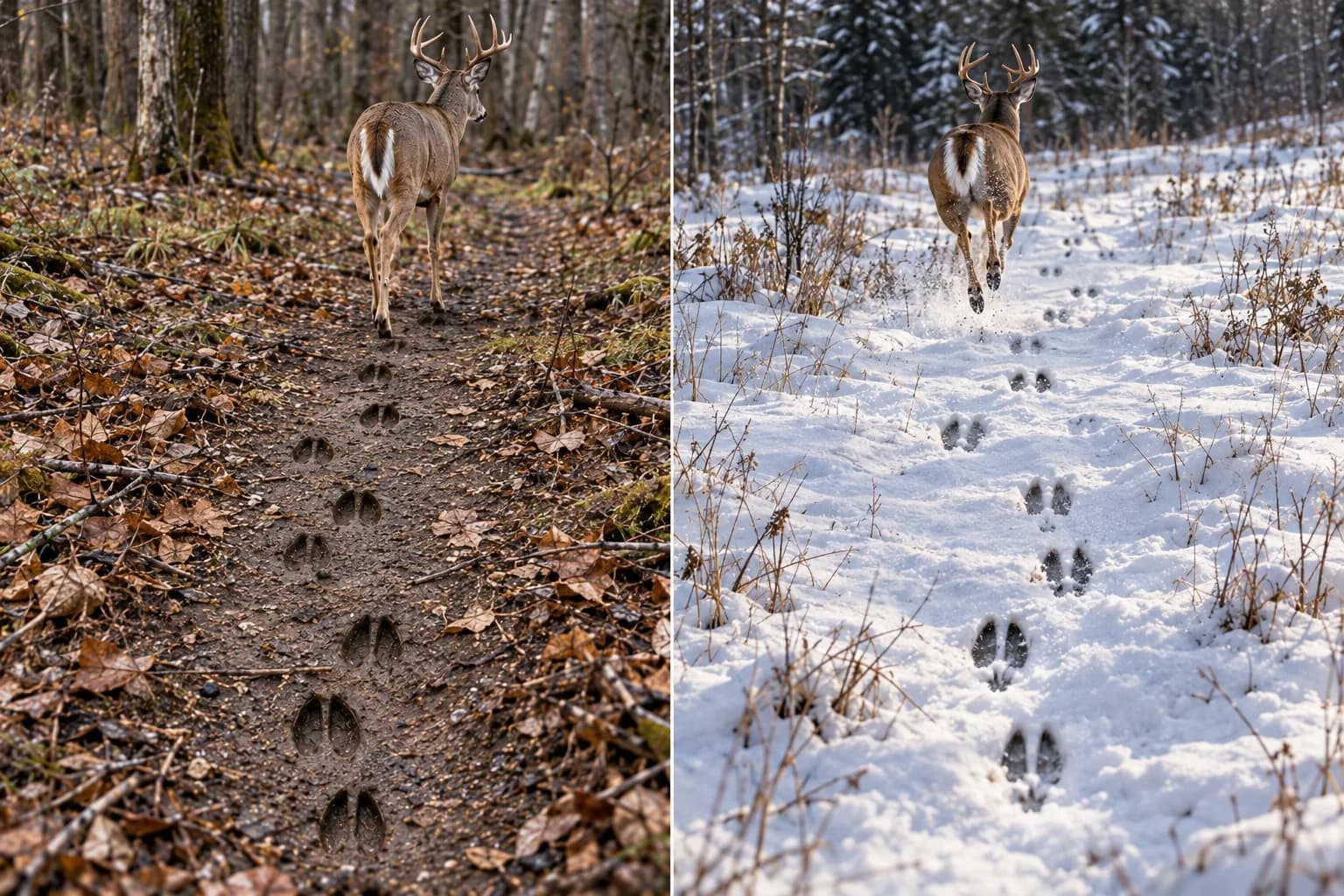
Tracks
Typical white-tail tracks have two pointed toes and a heart-shaped outline, but soft ground and speed can distort them. [4]
- Follow direction and repetition, not one perfect print.
- Track size cannot establish sex.
- The image is conceptual and not scale-calibrated.
Use the deeper track view as a pattern aid, never as a ruler.
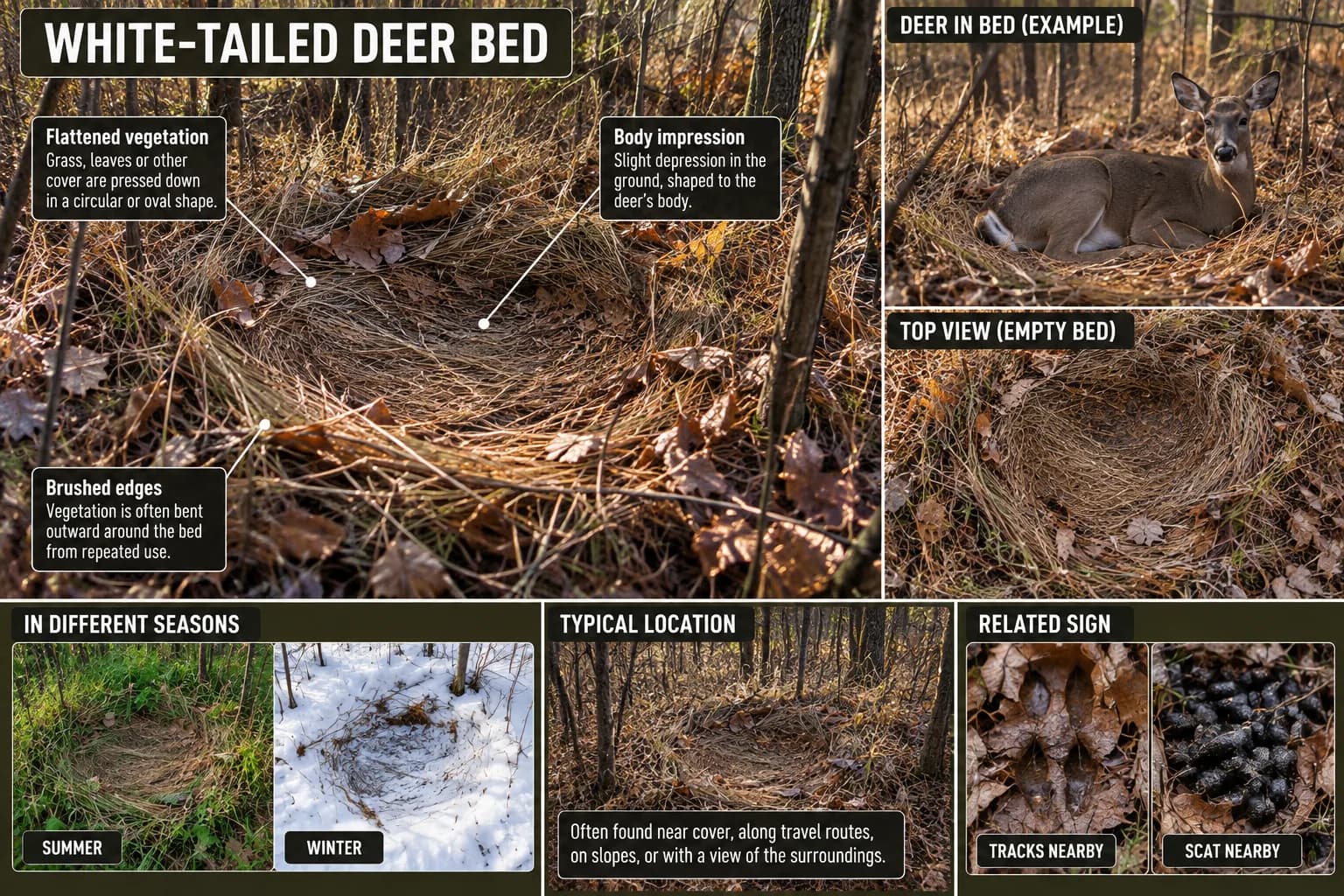
Beds
A flattened oval or body-shaped depression can mark a resting place, but it is not species proof by itself. [5]
- Look for tracks and pellets nearby.
- Repeated beds can reveal a bedding area.
- Do not push animals from sensitive winter cover.
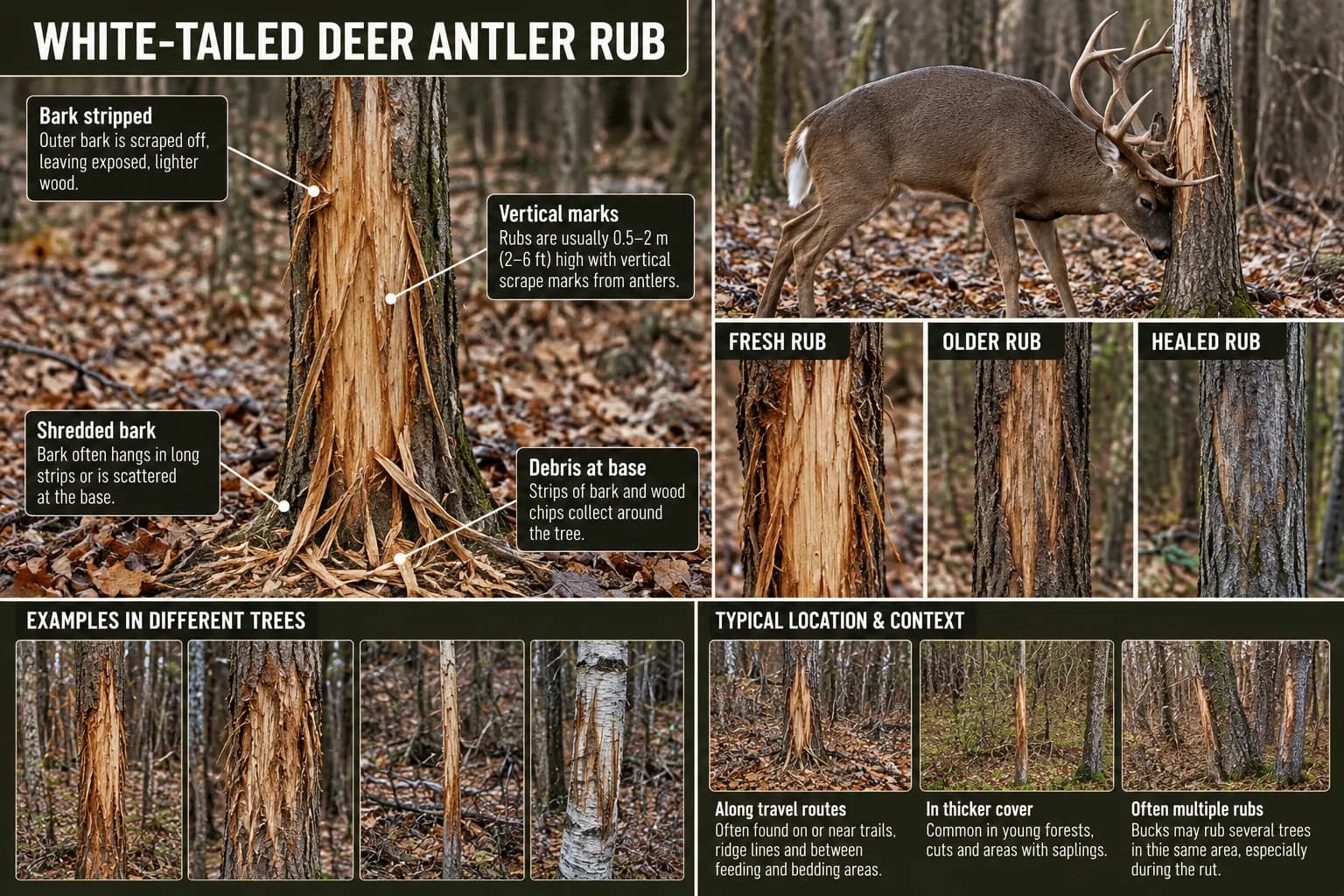
Antler rubs
Stripped bark and vertical scraping can indicate antler rubbing, usually by an antlered deer. [5]
- Freshness varies with moisture, bark and exposure.
- A rub does not promise daylight use.
- Several rubs may help reveal a route.
Browse
Clipped shoots or a browse line show repeated feeding pressure, not species identity. [6]
- Identify the plant and current availability.
- Pair browse with tracks or pellets.
- Fresh cuts age differently in sun, frost and rain.
Pellets
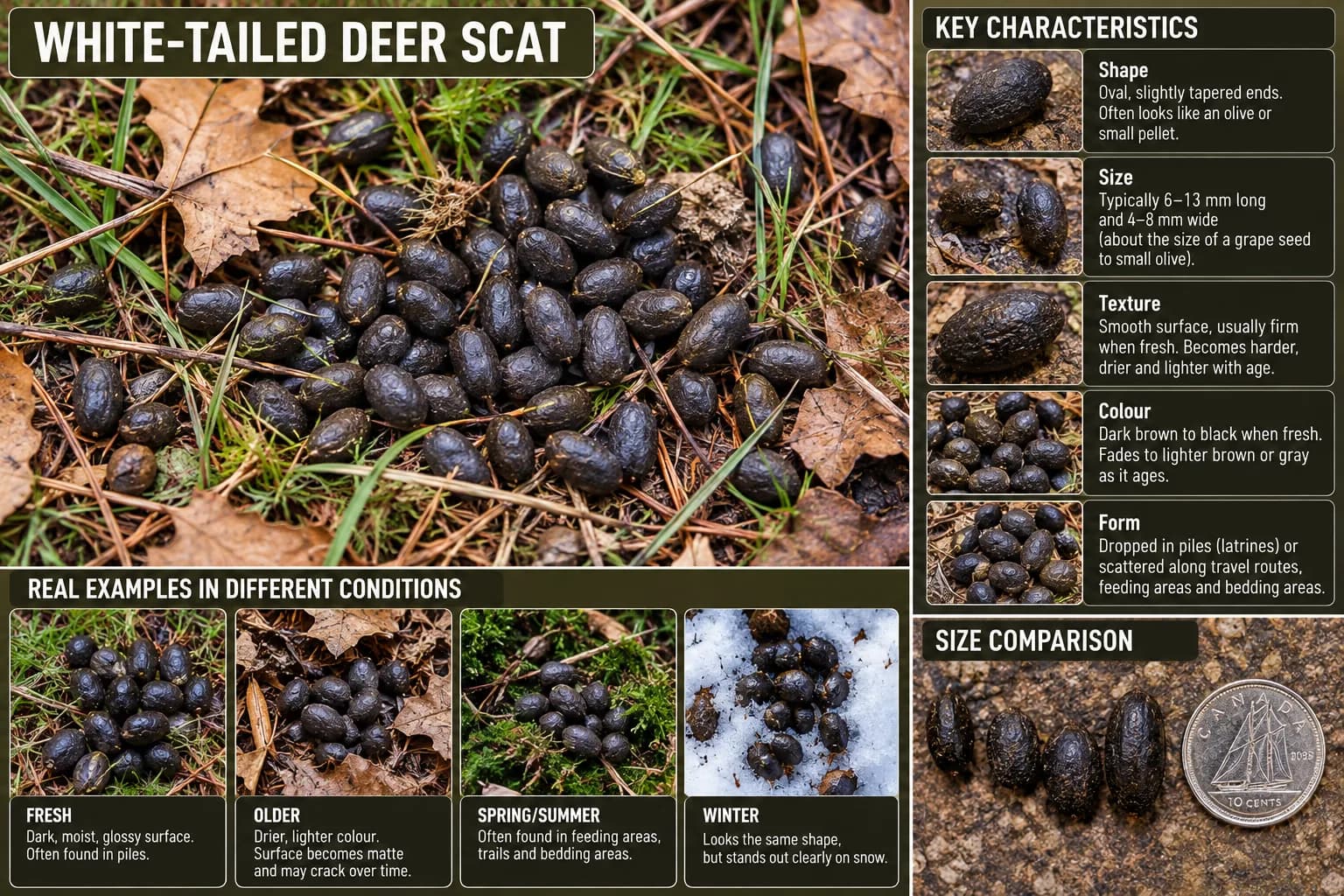
Droppings can confirm ungulate use, while shape and clumping vary with diet and moisture. [6]
- Avoid precise age claims from colour alone.
- Note whether deposits repeat along a route.
- Treat scat as supporting evidence, not a population count.
Several signs together
Confidence rises when fresh tracks, current browse, pellets and a used trail converge between plausible food and cover. [5]
- One clue suggests; several independent clues support.
- Recent weather provides the ageing context.
- State uncertainty when the evidence conflicts.
Interpret sign in context
Look for converging evidence: several fresh tracks, current droppings, browsed plants and a trail connecting known cover or food.
Moist edges, sharp detail, displaced leaves and sign laid over recent weather can suggest recency, but substrate and exposure change ageing quickly. State uncertainty plainly. [5]
Seasonal pattern
Season changes what deer need most: emerging forage in spring, security and growth in summer, breeding movement in autumn, and energy conservation plus shelter in winter.
Spring green-up and summer cover spread feeding opportunities. Does use secluded cover around fawning; observe from distance and leave apparently hidden fawns alone. [1]
Breeding occurs in autumn across much of the range, but peak timing and visible movement vary geographically and locally. Photoperiod is important; weather and pressure affect what hunters observe. [3][9]
Cold, deep snow and declining food can concentrate deer in sheltered habitat. Repeated disturbance then costs energy and can damage sensitive wintering areas. [7]
How to hunt
Find a current food-cover-travel relationship, confirm legal access and wind, then choose a low-impact position that offers a close, controlled shot.
Scout from large pattern to small proof: locate habitat transitions and funnels, then verify fresh sign and a safe approach before committing to a setup. [5]
Plan entry and exit around the wind and expected deer path. Avoid crossing the trail, bedding edge or feeding area you intend to observe. [9]
Still-hunting
Move slower than feels necessary, glass first and use cover to break your outline; stop more than you walk.
Still-hunting works best when wind, wet ground or soft snow reduce noise and visibility is sufficient to identify a deer and backstop before raising a firearm or bow. [9]
Stand or ground ambush
Set up downwind of a verified route, not directly on it, and retain a safe shot lane and exit.
Funnels, crossings and inside corners can concentrate travel, but stale sign and attractive map geometry do not replace present field evidence. [5]
Ethical shot placement
Wait for a broadside or modest quartering-away presentation that exposes the heart-lung area, with a clear path and safe backstop. If any part is uncertain, do not shoot.
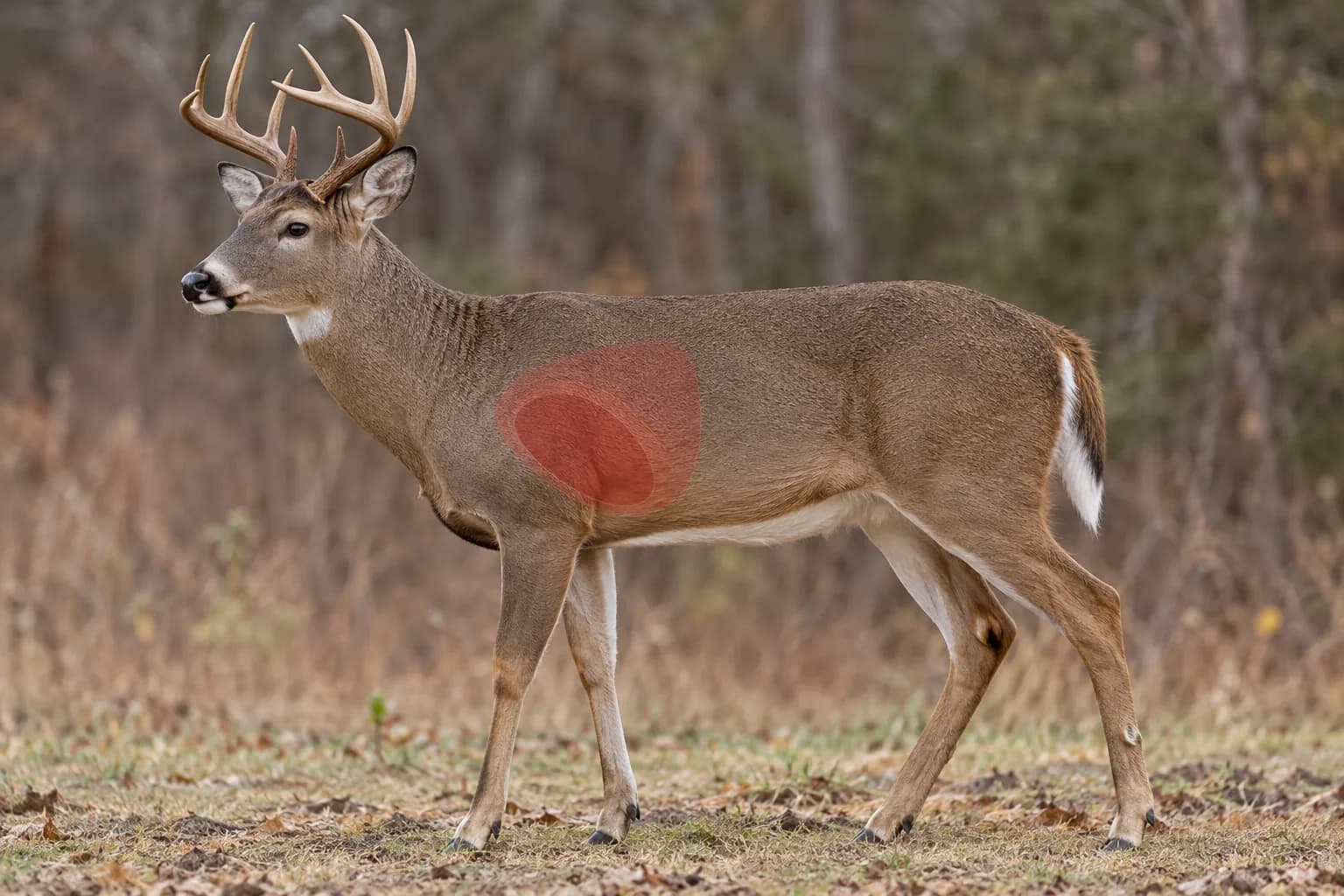
Aim through the centre of the chest's heart-lung area, accounting for the near and far legs and the animal's angle. The intended path matters more than a surface mark on the hide. [8]
Avoid head, neck, spine-only, rear-facing and steep quartering-to shots. They offer small targets, heavy bone or a poor path through both lungs and carry a higher wounding risk. [8]
After the shot, mark the exact location, watch the direction of travel, wait an appropriate interval and follow local retrieval rules. Never assume a miss because a deer did not fall immediately. [9]
Choose the angle before the target
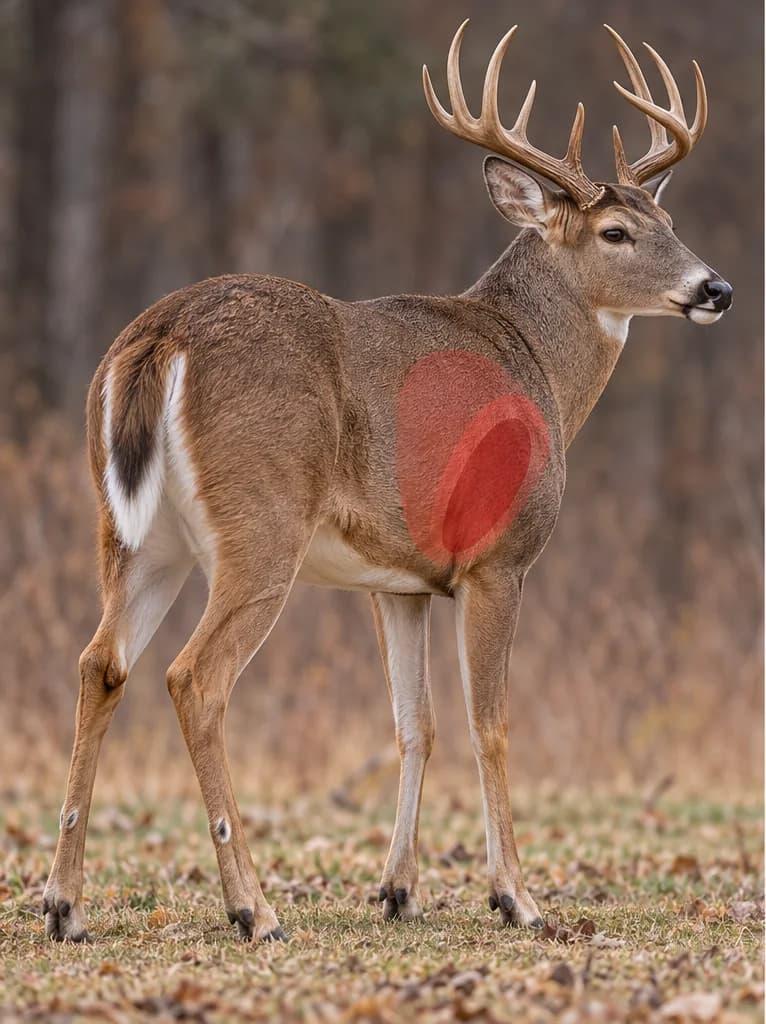
First decide whether the presentation permits a controlled path through the heart-lung area. The coloured region is deliberately broad: it is not a universal aiming dot.
Broadside
A calm, clear broadside presentation offers the most legible path through the chest's heart-lung area. [8]
Target region: the broad chest region immediately behind the near shoulder, adjusted for leg position and the intended exit path
- Confirm both near and far legs.
- Require an unobstructed path and safe backstop.
- Distance must remain inside your proven capability.
Modest quartering-away
A modest quartering-away angle can offer a controlled path through the chest; a steep angle should be passed. [8]
Target region: the near-side chest region that sends the path toward the far shoulder and through both lungs
- Visualize entry and exit, not a surface spot.
- Use the anatomy toggle to understand the path through the same registered pose.
- Pass if the angle becomes steep or the far lung is not credibly on the path.
Frontal
Pass on a frontal presentation: the vital path is narrow and heavy bone or a small angle error raises wounding risk. [8]
Target region: none—wait for a safer presentation
- Do not let proximity substitute for angle quality.
- Keep the muzzle or bow controlled while waiting.
- Let the deer leave if the presentation does not improve.
Quartering toward
Pass when the near shoulder and heavy bone block a dependable path through both lungs. [8]
Target region: none—wait for broadside or modest quartering-away
- A visible chest does not guarantee a clear vital path.
- Steeper angles make the path less forgiving.
- The supplied target plate was excluded because it implied a shot here.
Rear-facing
Pass on a rear-facing deer; there is no controlled, ethical path to the heart-lung area. [8]
Target region: none—do not shoot
- Wait without forcing movement.
- Maintain awareness of other hunters and boundaries.
- No image is needed to teach a no-shot decision.
This explorer does not make a hunt legal. Confirm the exact place, date, licence, animal class, equipment and current authority before hunting.
How to use the visual
Choose the angle first, then use the broad target region to visualize a path through the chest. Only the registered quartering-away pair offers an anatomy toggle.
Broadside uses an external-only view because its separate anatomy plate does not register to the same pose. Frontal and quartering-toward target plates are withheld because they conflict with the sourced pass decision. [8]
Field caution: Every shot depends on angle, distance, equipment, the hunter's capability, a clear target and what lies beyond.
Equipment
Use legal, well-maintained equipment that you can place accurately at the distance and angle offered. Regulation, proficiency and field conditions matter more than brand or maximum range.
Core field equipment includes an appropriate legal hunting implement and ammunition or arrows, positive identification optics, blaze clothing where required, navigation, weather protection, first aid and a retrieval plan. [9]
Confirm zero or tune, practice from realistic field positions and set a personal maximum distance based on repeatable groups—not the equipment's advertised capability. [8]
Regulations
This page does not tell you that a hunt is legal. A legal answer requires the exact place, date, licence, season, animal class, method and current authority source.
White-tailed deer are managed as game in many jurisdictions, but seasons, zones, tags, antler definitions, legal methods and reporting duties differ and change. Use Hunt for the covered place and date, then read the linked authority. [10]
A season does not grant access. Confirm land ownership, permission, discharge restrictions, protected areas and local rules separately. [10]
Conservation and protection
- THREATENED — Columbian white-tailed deer (Odocoileus virginianus leucurus), Columbia River (Clark, Cowliz, Pacific, Skamania, and Wahkiakum Counties, WA., and Clatsop, Columbia, and Multnomah Counties, OR.): listed as threatened under the Endangered Species Act since 1967-03-11. · ECOS species profile: Columbian white-tailed deer
- ENDANGERED — Key deer (Odocoileus virginianus clavium): listed as endangered under the Endangered Species Act since 1967-03-11. · ECOS species profile: Key deer
Where legal take is listed
- Alberta — hunting · 2026 Alberta Guide to Hunting Regulations
- British Columbia — hunting · 2026-2028 Hunting and Trapping Regulations Synopsis
- Manitoba — hunting · Manitoba Hunting Guide 2026
- New Brunswick — hunting · Hunt & Trap Regulations Summary 2026–2027
- Northwest Territories — hunting · NWT Summary of Hunting and Trapping Regulations, July 1 2022 - June 30 2023
- Nova Scotia — hunting · 2026 Hunting and Fur Harvesting Summary of Regulations
- Ontario — hunting · Ontario Hunting Regulations Summary — White-tailed deer
- Québec — hunting · Périodes de chasse pour le cerf de Virginie 2026-2027
- Saskatchewan — hunting · Saskatchewan Hunters Guide 2026-27
- Alabama — hunting · Deer Season 2026-2027 (ADCNR)
- Alaska — hunting · 2026-2027 Alaska Hunting Regulations: Fur Animals, Small Game, Unclassified Game, and Deleterious Exotic Wildlife (pp.140-142)
- Arizona — hunting · 2026-2027 Arizona Hunting Regulations
- Arkansas — hunting · 2026-27 Arkansas Hunting Guidebook (PDF)
- Colorado — hunting · 2 CCR 406-2 Chapter W-2 Big Game (05/06/2026; eff. 2026-07-01)
- Connecticut — hunting · 2026 Connecticut Hunting and Trapping Guide
- Delaware — hunting · 2026-27 Delaware Hunting & Trapping Guide: Deer Seasons
- Florida — hunting · 2026-2027 Florida Resident Game and Furbearer Hunting Season Dates and Bag Limits (FWC)
- Georgia — hunting · 2026-2027 Georgia Hunting and Fishing Regulations and Seasons (official WRD guide, publuu-hosted PDF, p.16)
- Idaho — hunting · Idaho Big Game 2026 Seasons & Rules
- Illinois — hunting · Illinois Digest of Hunting and Trapping Regulations 2026-2027 (PDF read from cached copy of the digest linked on this page)
- Indiana — hunting · Indiana Hunting & Trapping Guide 2026-2027: Deer Seasons, Licenses & Equipment
- Iowa — hunting · 2026-27 Iowa Hunting, Trapping & Migratory Game Bird Regulations (DNR PDF; page numbers cited)
- Kansas — hunting · KDWP Deer Regulations 2026
- Kentucky — hunting · Kentucky Hunting & Trapping Guide, August 2026-March 2027
- Louisiana — hunting · 2026-2027 Louisiana Hunting Regulations (updated Aug 7, 2026)
- Maine — hunting · 2026-27 Maine Hunting Seasons (Summary of Laws & Rules)
- Maryland — hunting · 2026-27 Maryland Guide to Hunting & Trapping (official guide, linked from dnr.maryland.gov/huntersguide)
- Minnesota — hunting · Minnesota Hunting & Trapping Regulations (effective July 2026 - June 30, 2027)
- Mississippi — hunting · 2026-2027 Hunting Seasons (MDWFP PDF)
- Missouri — hunting · A Summary of Missouri Hunting and Trapping Regulations 2026
- Montana — hunting · 2026 Deer, Elk, Antelope Hunting Regulations
- Nebraska — hunting · Big Game Guide 2024
- New Hampshire — hunting · Fis 300 Wildlife Seasons and Rules
- New Mexico — hunting · 2026-2027 New Mexico Hunting Rules & Information (v08.11.26)
- North Carolina — hunting · Hunting and Trapping Season Dates for July 1, 2026, through June 30, 2027 (NCWRC)
- North Dakota — hunting · 2026 Deer Hunting Proclamation
- Ohio — hunting · Ohio Hunting and Trapping Regulations 2026-27 (effective 1 Sep 2026-31 Aug 2027); PDF read from cached copy
- Oklahoma — hunting · Deer - Big Game Season
- Oregon — hunting · 2026 Oregon Big Game Hunting Regulations (official ODFW booklet, eRegulations host linked from myodfw.com)
- Pennsylvania — hunting · 2026-27 Seasons and Bag Limits
- Rhode Island — hunting · Hunting and Trapping Regulations (250-RICR-60-00-9)
- South Carolina — hunting · 2026-2027 South Carolina Hunting & Fishing Laws and Regulations Guide
- South Dakota — hunting · 2026 South Dakota Hunting and Trapping Handbook
- Tennessee — hunting · Summary of Tennessee Hunting and Trapping Seasons Dates | TWRA
- Texas — hunting · White-tailed Deer: 2026-2027 Seasons & Regulations
- Utah — hunting · 2026 Big Game Field Regulations Guidebook
- Vermont — hunting · Hunting and Trapping Seasons (web page)
- Virginia — hunting · Deer Hunting Regulations and Seasons | Virginia DWR
- Washington — hunting · WAC 220-400-020 Classification of wild animals
- West Virginia — hunting · West Virginia 2026-2027 Hunting Season Dates | WVDNR
- Wisconsin — hunting · 2026 Wisconsin Hunting and Trapping Seasons PUB-CS-076-2026 (updated 06/08/2026)
- Wyoming — hunting · WGFC Ch. 6 Deer Hunting Seasons (dated Apr 22 2026)
Being listed is not an open season. Seasons, zones, licences, methods and limits decide whether this animal may be taken on a given day and place — check Hunt or the authority before you go. Listings read 2026-09-30.
Range and map
North Ground's Species Heat layer shows range-constrained habitat opportunity—not animals, population density, property access or an open season.
White-tailed deer occur broadly across southern Canada, most of the continental United States and farther south, but distribution and abundance are patchy and change with habitat and climate. [1]
The current North Ground layer is a production-verified RANGE_HABITAT surface at approximately 11 km habitat resolution. Its confidence is moderate and its source age is reported as ageing; use it to choose where to investigate, then verify in the field. [11]
Frequently asked questions
Short answers to the field questions most likely to change an identification, scouting or ethical-shot decision.
Is every deer with white on its tail a white-tailed deer?
No. Confirm the broad white underside and use rump pattern, ears, antlers, gait and local range together. [3]
When is the white-tail rut?
Autumn across much of the range, but timing varies by latitude and local population. Do not treat one calendar week as universal. [3]
Can track size identify a buck?
No. Substrate, gait and individual size overlap; a large track may support an interpretation but cannot establish sex by itself. [4]
Does a hot map cell mean deer are there?
No. It means the model found comparatively stronger range-constrained habitat opportunity at its stated resolution—not a current animal count. [11]
Does this page mean I can hunt white-tailed deer here today?
No. Check the exact location and date in Hunt and verify the linked authority, licence, access, method and animal-class requirements. [10]
Sources and review
Claims are linked to biological, field, hunting-education, regulatory and geospatial sources. Source type is shown because one kind of evidence cannot silently answer another kind of question.
- BIOLOGICALWhite-tailed Deer
Hinterland Who's Who / Canadian Wildlife Federation · reviewed 2026-10-06
Canadian biology, range, life cycle and behaviour overview.
U.S. Forest Service · reviewed 2026-10-06
Research synthesis for habitat, food habits, cover and regional variation.
- BIOLOGICALWhite-tailed Deer
North Dakota Game and Fish Department · reviewed 2026-10-06
Identification, description, food, habits and reproduction.
- FIELD GUIDANCEWhite-tailed Deer field guide
Missouri Department of Conservation · reviewed 2026-10-06
Track form, dimensions and field signs.
- FIELD GUIDANCEDeer scouting basics
Indiana Department of Natural Resources · reviewed 2026-10-06
Trails, funnels, rubs, scrapes and sign interpretation.
- FIELD GUIDANCEDeer species facts
Washington Department of Fish and Wildlife · reviewed 2026-10-06
Tracks, trails, browse and coexistence signs.
- BIOLOGICALWhite-tailed Deer
Maine Department of Inland Fisheries & Wildlife · reviewed 2026-10-06
Northern winter habitat, diet and survival context.
- HUNTING EDUCATIONTaking Your Shot
Illinois Natural History Survey · reviewed 2026-10-06
Anatomy, heart-lung target, shot angles and ethical selection.
- HUNTING EDUCATIONWhite-tailed deer hunting guide
Government of Ontario · reviewed 2026-10-06
Ontario deer biology, hunting practice, safety and retrieval.
- REGULATORY AUTHORITYOntario hunting regulations summary
Government of Ontario · reviewed 2026-10-06
Current authority handoff for Ontario rules; page content is not a substitute.
North Ground · reviewed 2026-10-06
Production-verified range-and-habitat model, methodology, confidence and limitations.
Visual asset manifest
Original educational artwork is listed with its intrinsic dimensions and publication decision. Optimized WebP derivatives are used in the explorers; the supplied originals remain unchanged.
- Antler-rub field signsUSED
1536 × 1024 · sign explorer · Use as educational artwork, not proof of freshness or current occupancy.
/White tail deer/white-tailed-deer-antler-rub.webp - Deer-bed field signsUSED
1536 × 1024 · sign explorer · Pair bed shape with tracks, pellets and surrounding cover.
/White tail deer/white-tailed-deer-bed.webp - Bedding-cover examplesUSED
1536 × 1024 · habitat explorer · Describe cover function rather than promise deer presence.
/White tail deer/white-tailed-deer-bedding habitat.webp - Browsed-vegetation signsUSED
1536 × 1024 · sign explorer · Do not identify deer from browse alone.
/White tail deer/white-tailed-deer-browsed-vegitation.webp - Seasonal feeding habitatUSED
1536 × 1024 · diet explorer · Season dates and foods are examples, not a universal calendar or local prescription.
/White tail deer/white-tailed-deer-feeding-habitat.webp - Adult buck identificationUSED
1536 × 1024 · identification explorer · Use several field marks; antlers and body size alone are not decisive.
/White tail deer/white-tailed-deer-identification-buck.webp - Pellet and scat examplesUSED
1536 × 1024 · sign explorer · Shape varies with diet and moisture; never age sign precisely from appearance alone.
/White tail deer/white-tailed-deer-scat.webp - Sex and age comparisonREVIEW REQUIRED
1536 × 1024 · candidate comparison plate · Do not publish: the embedded claim that fawn spots are year-round is false; body-build generalizations are also too absolute.
/White tail deer/white-tailed-deer-sex-age-comparison.webp - Broadside internal anatomyREVIEW REQUIRED
1675 × 939 · candidate anatomy reference · Do not publish until veterinary/anatomical review; it is not registered to the external broadside asset and simplifies digestive anatomy.
/White tail deer/white-tailed-deer-shot-broadside-anatomy.webp - Broadside external target regionUSED
1536 × 1024 · shot explorer · Treat the overlay as a broad heart-lung region, never a universal aiming point.
/White tail deer/white-tailed-deer-shot-broadside-external.webp - Frontal shot target and anatomyNOT USED
1536 × 1024 · candidate shot plate · Not used: the target overlay conflicts with this page's sourced pass/no-shot guidance for frontal presentations.
/White tail deer/white-tailed-deer-shot-frontal-anatomy.webp - Quartering-toward target and anatomyNOT USED
1536 × 1024 · candidate shot plate · Not used: the target overlay conflicts with this page's sourced pass/no-shot guidance for quartering-toward presentations.
/White tail deer/white-tailed-deer-shot-quartering forward-anatomy.webp - Quartering-away external and anatomy pairUSED
1536 × 1024 · shot explorer · Use only for a modest angle; show external and anatomy halves without stretching and reset the view when angle changes.
/White tail deer/white-tailed-deer-shot-quartering-away-anatomy.webp - Track-line examples in soil and snowUSED
1536 × 1024 · track subview · Conceptual only; the artwork is not scale-calibrated and must not be used to infer sex or exact size.
/White tail deer/white-tailed-deer-track-patterns.webp - Track anatomy diagramREVIEW REQUIRED
1536 × 1024 · candidate track subview · Do not publish: its rounded-tip comparison conflicts with the sourced pointed, heart-shaped field mark and its gait labels need review.
/White tail deer/white-tailed-deer-tracks-diagram.webp - Travel-corridor examplesUSED
1536 × 1024 · habitat and sign synthesis · A corridor is a hypothesis until current sign confirms use.
/White tail deer/white-tailed-deer-travel-corridor.webp - White-tail and mule deer comparisonUSED
1536 × 1024 · identification comparison · Use tail, ears, antler branching and gait together; do not rely on the plate's body-build generalizations.
/White tail deer/white-tailed-deer-vs-mule-deer.webpg.png